Beneath the rubble: Gaza's painful search for the dead begins
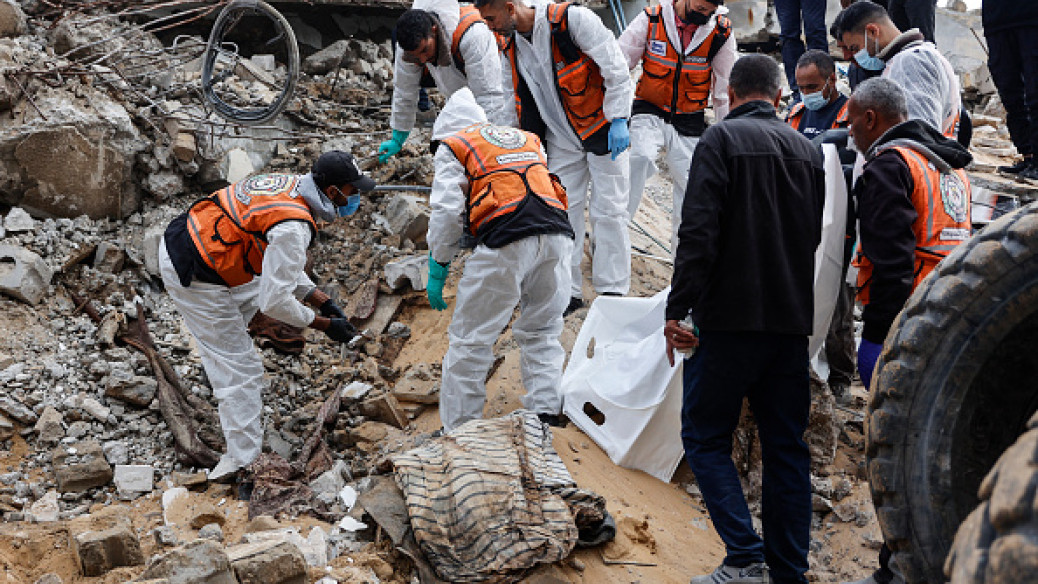
The General Directorate of Civil Defence in the Gaza Strip on Monday began the first phase of operations to recover the bodies of Palestinians buried beneath the rubble of homes partially or completely destroyed during Israel’s genocidal war on Gaza.
The operation is being carried out in cooperation with the International Committee of the Red Cross.
Civil Defence spokesperson Mahmoud Basal announced the start of search operations to recover the bodies of people killed when Israeli forces bombed small residential buildings in Gaza City with residents still inside. The initial phase is focusing on homes targeted in the early months of the war.
The humanitarian operation began at the destroyed home of the Abu Ramadan family in central Gaza City, where dozens of displaced people had been sheltering. The house collapsed under intense Israeli bombardment, leaving dense layers of rubble packed into a confined space.
Rescue teams are working under severe logistical and technical constraints, facing extreme difficulty due to tightly interlocked debris, unstable structures and the limited space available for the small number of machines currently in use.
Speaking at a press conference ahead of excavation work, Basal said civil defence crews would continue searching for bodies within the limited projects currently available, while waiting for other parties to provide bulldozers, excavators and heavy breakers needed to complete the humanitarian mission.
He stressed that civil defence teams possess no heavy rescue equipment and are forced to work with basic tools after the Israeli occupation destroyed most of the agency’s infrastructure and capabilities during the war.
"We began work only after the Red Cross provided a bulldozer in Gaza City, alongside another bulldozer already present in the central area," Basal said.
According to Basal, the civil defence requires at least 20 bulldozers and 20 excavators to recover thousands of bodies still trapped beneath the rubble, allowing families to bury their loved ones with dignity in accordance with religious and humanitarian principles.
He noted that international humanitarian law, human rights law and the Geneva Conventions require respect for the bodies of the dead, preservation of their dignity and clarification of the fate of those killed.
Basal questioned what he described as the silence of the international community and its double standards in defining "humanity", pointing to the contradiction between these positions and the principles of international humanitarian and human rights law.
He said heavy equipment was swiftly allowed into Gaza to locate the bodies of a small number of Israeli captives, while assistance continued to be denied to the civil defence and relevant bodies attempting to recover the remains of thousands of Palestinians missing beneath destroyed homes.
Basal renewed calls on the International Civil Defence Organisation and the guarantors of the Gaza ceasefire to urgently intervene to allow the entry of heavy machinery. He also urged humanitarian organisations to take part in projects aimed at locating and recovering the bodies.
The civil defence appealed to families to cooperate in identifying remains, warning that many bodies are expected to be decomposed, with altered features or reduced to skeletal remains. In some cases, no trace may be found due to the scale and intensity of explosives used by Israeli forces against residential buildings.
Following the press conference, attention turned to the first field site where rescue teams began work at the destroyed Abu Ramadan family home. Civil defence crews operated cautiously and in coordination between excavation and rescue teams amid unstable rubble and underground cavities.
Palestinian Abu Ibrahim Salem, from the Beit Lahia project in northern Gaza, who lost nearly 100 family members in the attack, said that in December 2023, during the third month of the war and the Israeli ground invasion, his family fled a suffocating siege and sought refuge in what they believed was a safe area in Gaza City.
Speaking to The New Arab's Arabic language edition, Salem said around 113 relatives had gathered in the Abu Ramadan family home, to whom they were related by marriage.
"It was bombed over the heads of everyone inside, elderly people, children and women, without any prior warning. Only 13 people survived, with varying injuries," he said.
He added that 97 people had remained buried beneath the rubble despite repeated appeals to international, local and official bodies.
"The responses were always negative until today, when this important step was finally taken, allowing us at last to bid farewell to our relatives and bury them in a way that respects their human dignity," he said.
Operations are being carried out according to clear protocols, including securing the site, conducting safety checks, documenting cases by name when possible and transferring remains to medical and forensic points.
Relevant authorities are involved to facilitate procedures for handover and burial.
The campaign is not aimed solely at removing bodies, but at documenting them and handling them in a humane manner that honours the dignity of those killed and helps families identify and bury their loved ones, despite the extreme danger posed by unstable rubble and destruction left behind by Israel's bombardment and continued breaches of the October ceasefire.